Highway Advertising: The Approach for Flitsmeister
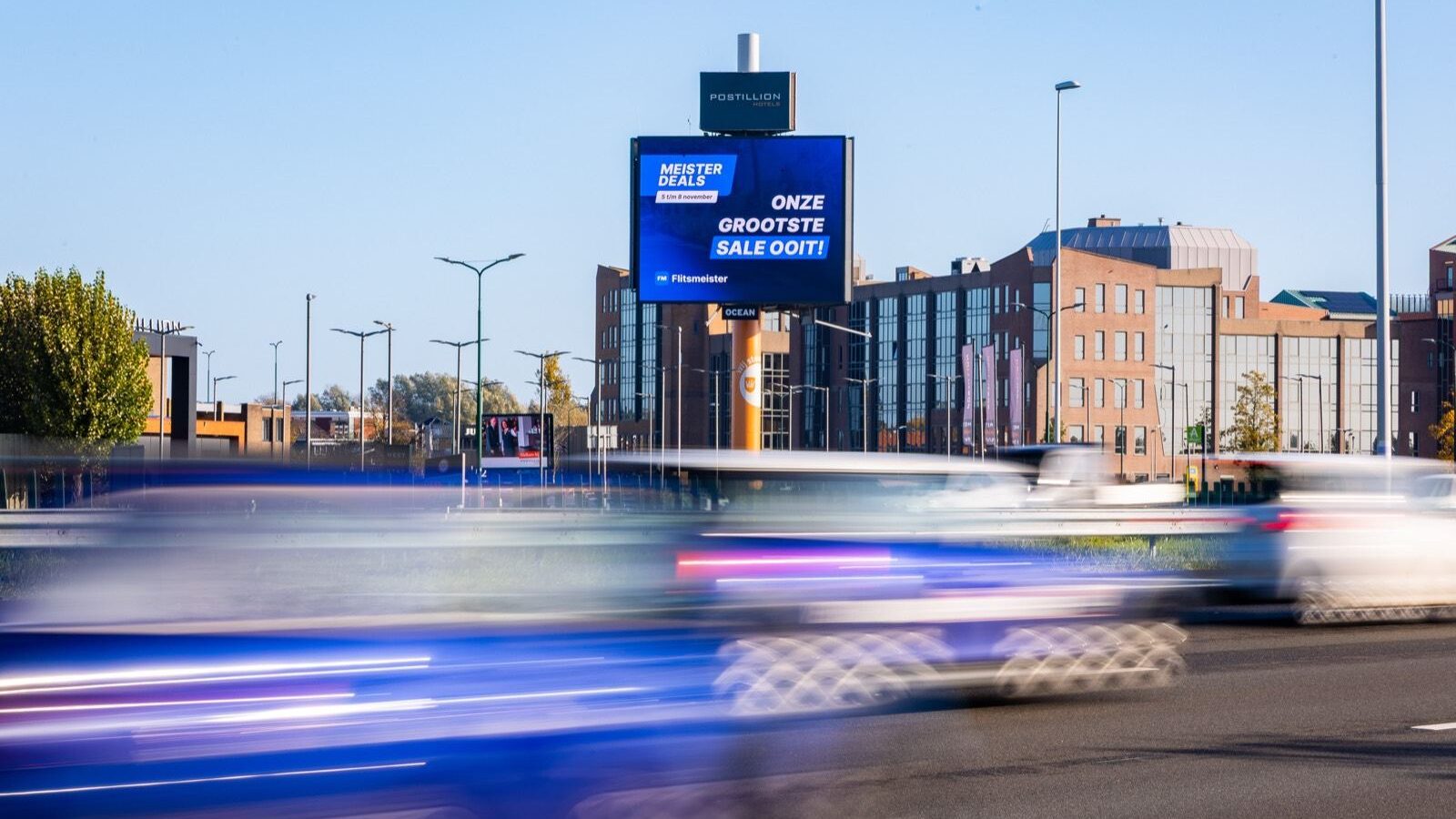

Flitsmeister wanted to be visible where drivers are. There’s really only one place: the highway. For the “Meister Deals” campaign, Flitsmeister appeared on 151 digital highway billboards throughout the Netherlands from October 29 through November 8. But before we recommended a single billboard, we first calculated the potential return on investment of highway advertising. Below, you can read how we built up the reach step by step.
The question: making the driver's location visible
Flitsmeister is an app for use on the go. Its users are in their cars. For a nationwide promotional campaign in the fall, Flitsmeister sought to reach a wide audience of drivers throughout the Netherlands. Outdoor advertising played a key role in this effort: building brand awareness and recognition. The campaign is being promoted through the company’s own channels.
For a brand you use while on the go, the highway is the obvious choice. That’s where the target audience is, at the very moment the product is used most often. So the question wasn’t whether we would advertise along the highway, but how to reach as many people as possible there.
Step 1: Who do you actually reach with a highway billboard?
With a highway tower, you can only reach people who are driving on the highway. That sounds logical, but it’s often not reflected in many plans. Those plans list a coverage percentage for the entire country, even though a large portion of the population rarely or never passes by a tower.
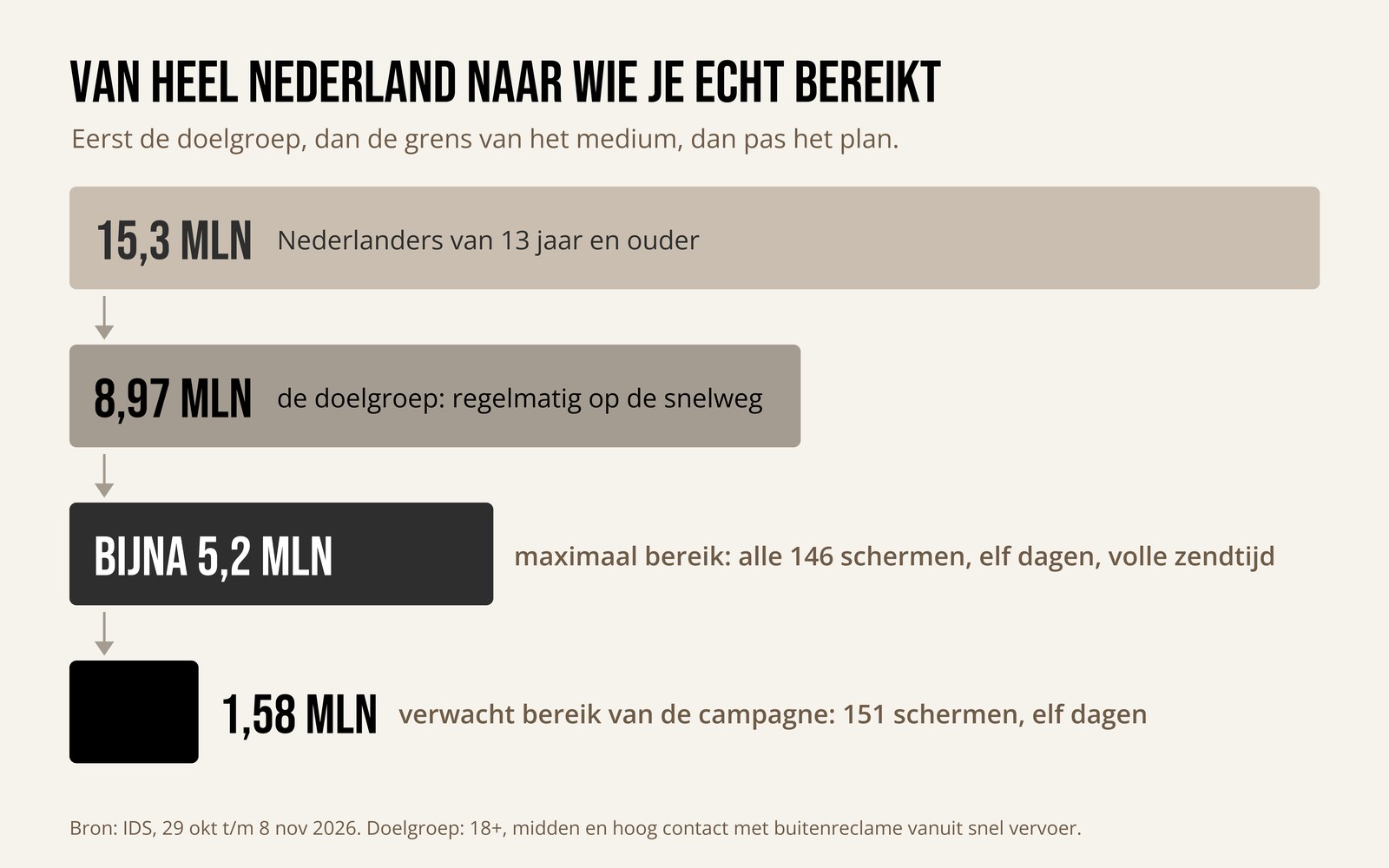
The national outdoor advertising survey categorizes people based on how often they encounter outdoor advertising while traveling by car or other forms of rapid transportation. We included people aged 18 and older who do so regularly or frequently: 8,969,850 people. That represents 58.5% of all Dutch residents aged 13 and older, and the entire audience for this medium.
Each reach percentage in our plan is a percentage of those 8.97 million. That figure then tells us something about the people who actually drive.
Step 2: Where are the limits of the medium?
Next, we calculated the maximum reach. The study includes 146 digital highway billboards. We set them all to 100% airtime for 11 days, something that is never actually purchased in practice. The result: nearly 5.2 million people, or 57.9% of the target audience.
That’s not a scenario, but a benchmark. More than 40% of drivers won’t see a single digital highway sign during those eleven days. If you want to reach more people, you need a second medium. More airtime on the same screens hardly helps, and even advertising for longer periods has only limited effect. Four weeks of full airtime results in a reach of 67.3%.
We show you that limit up front. That way, you'll know what's realistic before you make a decision.
Step 3: The number of screens determines the range
Then we wanted to know which approach would yield the greatest reach. To do that, you need a fixed benchmark. We chose a fixed number of contacts: 2.4 million in eleven days, and calculated the different ways to reach that number: with many screens and little airtime, with few screens and a lot of airtime, during peak hours, or throughout the day. The number itself is a benchmark. It’s the differences that matter.
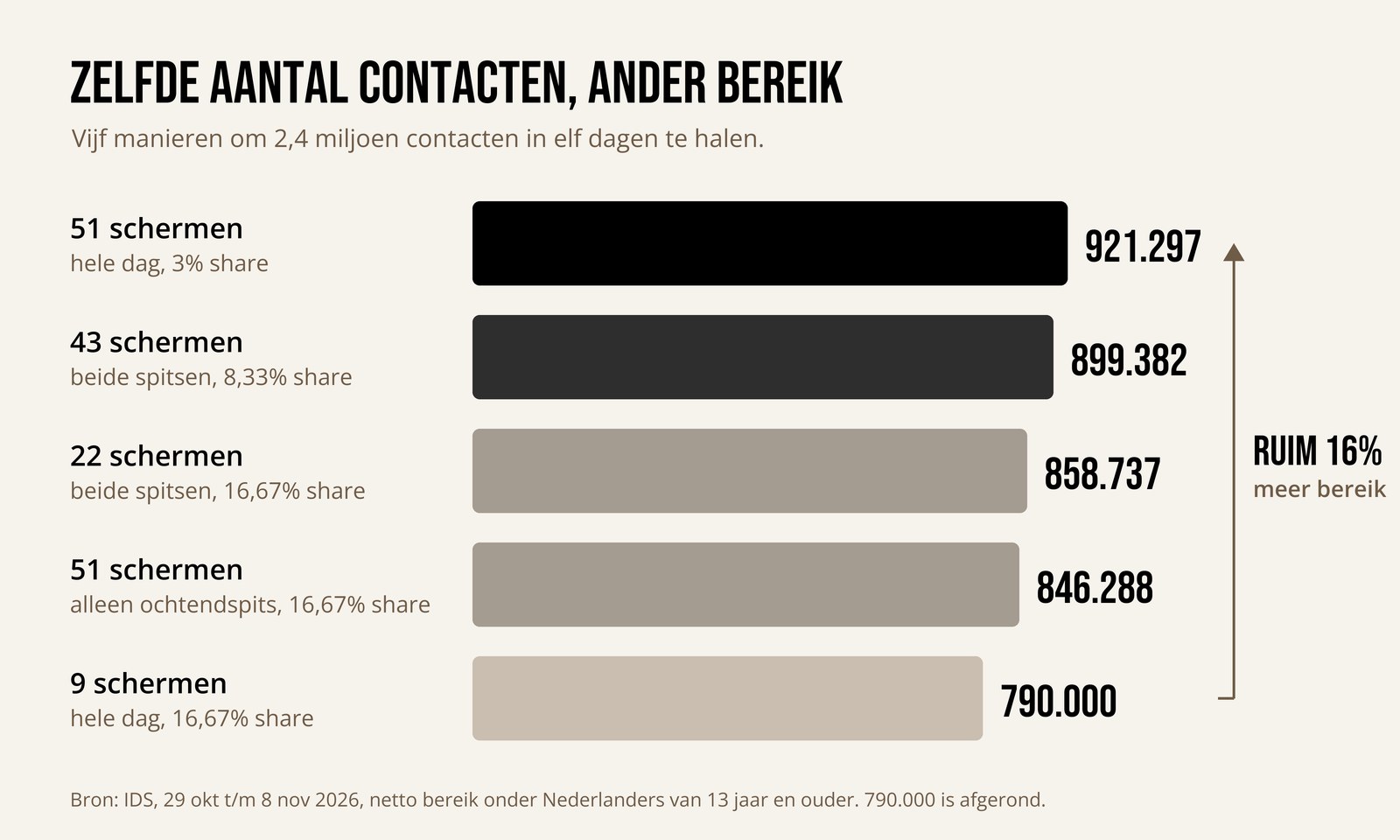
The same number of contacts, and yet a difference of more than 16% in reach between the best and the weakest route. The explanation: during rush hour, largely the same commuters pass by every day. More hours or a higher share in the same location mainly results in repeat exposure, not new people. Each additional screen is located along a different traffic flow and adds new people.
A low share of time is therefore primarily a way to deploy more screens. To learn what contacts are and how they’re calculated, read our article on how the reach of outdoor advertising is measured.
Step 4: Both points, half a share
Flitsmeister wanted to be visible during rush hour. That’s when the target audience is on the go and the app is used the most. The comparison showed the smartest way to do that. The plan therefore called for a half-share of time during both rush hours: 8.33%, or one-twelfth of the airtime.
This way, you reach 6% more people than you would with a single rush hour spot at full share, and you’re only 2% below the all-day average. Moreover, the morning and evening rush hours largely reach different audiences. On one side of the billboard along the A5, the overlap between the two rush hours was only 2%. On weekends, when there’s no rush hour, the campaign ran from 9:00 a.m. to 12:00 p.m.
Step 5: Three Scenarios, One Difference
Only then did we present the scenarios. There were three of them, all identical except for one thing: the number of screens. This allowed Flitsmeister to see exactly what each step would yield.
| Fencing | Net reach | Target Audience | Whereas |
|---|---|---|---|
| 50 | 615.473 | 6,9% | 1,27× |
| 73 | 917.500 | 10,2% | 1,35× |
| 151 | 1.584.215 | 17,7% | 1,59× |
Each step adds new locations, and thus new people. From 50 to 73 screens, the reach grows by nearly half; from 73 to 151 screens, it grows by another 73%. Frequency also increases: with 151 screens, a person sees the ad an average of 1.59 times. Flitsmeister opted for the largest scenario: 151 digital highway screens on about 90 poles, stretching from Zeeland and Friesland deep into Limburg.
The reach for that scenario was calculated based on the 146 screens included in the study. The other five are also included, so in reality, the reach is actually slightly higher.
What Sets Us Apart
A common approach starts with the budget: a certain amount of contacts for a certain amount of money, a half-day of ad time based on intuition, and a reach figure covering the entire Netherlands. Often, ad space is then purchased on contacts. That provides a lot of volume, but you don’t know in advance where and when your campaign will run. And so, afterward, you also don’t know how many people you actually reached.
We flip that around: measure first, then advise. We calculate the reach among the people you can actually reach with a particular medium, and we show you in advance where the limits lie. We run the same volume through different scenarios so you can see what a specific time slot really delivers. And we purchase fixed screens and time slots, so the reach can be predicted in advance and accounted for afterward.
This way, you make your decision based on what a plan delivers, rather than what it costs.
The Campaign at a Glance
- Client: Flitsmeister, "Meister Deals" promotion.
- Deployment: 151 digital highway signs, nationwide.
- Period: October 29 through November 8, 2026.
- Time periods: on weekdays during both rush hours; on weekends from 9:00 a.m. to 12:00 p.m.
- Expected net reach: 1,584,215 drivers, 17.7% of the target audience.
The lesson: highway advertising can be much more strategic
Outdoor advertising is still often purchased based on gut feeling: a few attractive locations, a time slot that seems logical. But with data from the national survey, you can gain a much deeper understanding. Who are you actually reaching, where are the limits, and which route gets the most out of the same budget? If you answer those questions in advance, you’ll get more out of the same campaign.
Want to learn more about this medium? Read more about digital highway billboards, or see what we’re doing for a national campaign.
Frequently Asked Questions
Can you reach the entire Netherlands using highway poles?
No. Highway billboards reach people who regularly drive on the highway: about 9 million Dutch people aged 18 and older. If you run all 146 digital highway billboards included in the study at full capacity for 11 days, you’ll reach nearly 5.2 million of them. If you want to reach more people, combine billboards with another medium.
Is advertising during rush hour better than advertising all day?
Not necessarily for reach. With the same volume, you’ll reach slightly more people by running your ad all day at a low share, because the same commuters drive by every day during rush hour. If you specifically want to be visible during rush hour, choose both rush hours at half share instead of one rush hour at full share.
How long does a spot last on a digital highway billboard?
A commercial lasts six seconds. You don’t buy a fixed spot in a rotation, but rather visibility: a portion of the airtime on a screen, known as the “share of time.” At 8.33%, your ad appears on screen for, on average, one-twelfth of the time. The higher the share, the more often someone driving by will see your ad.
Want to advertise more effectively along the highway? Schedule a free strategy session.